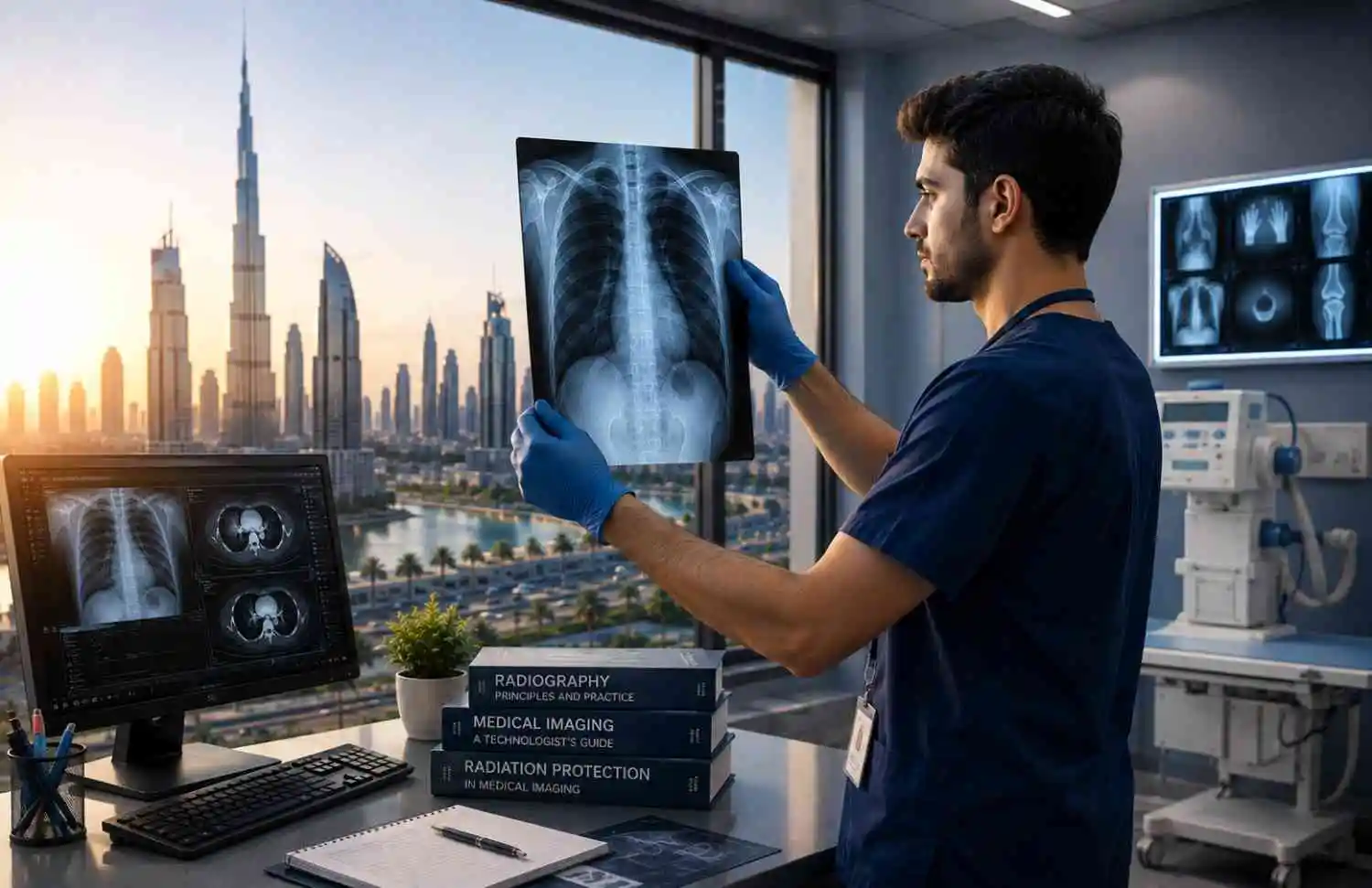
UAE Radiographer License Complete Guide 2026: DHA, DOH, SHA & MOHAP Exams Explained
Why a License Is Non-Negotiable for Radiographers in the UAE
If you're a radiographer eyeing a career in the UAE, there's one hard truth you can't skip: you cannot legally practice without a license from the health authority governing your chosen emirate. Whether it's a government hospital in Abu Dhabi or a private diagnostic center in Dubai, the rules are strict — and for good reason. Medical imaging directly impacts patient diagnosis and safety, so every authority wants proof that you're competent before you touch the equipment.
The good news? The UAE's healthcare sector is booming, and radiographers are in steady demand across both public and private facilities. The catch is that each emirate has its own licensing body, and each one comes with a different set of rules. Get familiar with them now, and you'll save yourself months of confusion later.
The Four Licensing Authorities You Need to Know
Depending on where you plan to work, you'll need to clear the exam conducted by one of these four bodies:
|
Authority |
Emirate(s) Covered |
|
DHA (Dubai Health Authority) |
Dubai |
|
DOH (Department of Health) |
Abu Dhabi |
|
SHA (Sharjah Health Authority) |
Sharjah |
|
MOHAP (Ministry of Health and Prevention) |
Ajman, Fujairah, Ras Al Khaimah, Umm Al Quwain (Northern Emirates) |
Although these examinations have similar objectives, they differ in eligibility criteria, exam pattern, and syllabus. Let's break each one down.
1. Dubai Health Authority (DHA)
DHA runs one of the most structured licensing systems in the region, with separate exams tailored to your qualification and specialization. Here's how the categories break down.
A. DHA Radiography Technician
Who qualifies?
- A 2-year (minimum) diploma in Radiography plus at least 2 years of post-qualification experience, or
- A Bachelor's degree in Radiography/Medical Imaging plus at least 1 year of post-qualification experience
Exam format:
- 3 hours long
- 150 multiple-choice questions
- Computer-based test
- Pass mark: 45%
Major Topics
- Radiation Protection
- X-ray
- CT
- MRI
- Ultrasound
- Nuclear Medicine
- Angiography
- Fluoroscopy
- General Anatomy
- Patient Safety
- Professionalism & Ethics
B. DHA Radiographer / Radiography Technologist
Who qualifies?
- Bachelor's Degree in Radiography / Medical Imaging
- Minimum 2 years post-qualification experience
Exam format:
- 3 hours, 150 MCQs
- Pass mark: 55%
How it's different from the Technician exam: This one goes deeper — it's competency-based rather than purely knowledge-based, and evaluates you across five domains:
- Professional Practice
- Patient Management
- Health & Safety
- Operation of Equipment
- Procedure Management
Although the exam is reported under these five competency domains, the questions cover the entire radiography syllabus, including X-ray, CT, MRI, Ultrasound, Nuclear Medicine, Fluoroscopy, Radiation Protection, Patient Care, Anatomy, Professional Practice, Ethics, and related clinical concepts.
This means that questions are not grouped by modality. Instead, a question from any area of the syllabus may assess one or more competency domains, requiring candidates to apply both theoretical knowledge and clinical judgment.
C. DHA MRI Technologist
Who qualifies? There are a few paths in:
Option 1
- Bachelor's Degree or Diploma (minimum 3-year course) in MRI
OR
Option 2
- Bachelor's Degree in Radiography / Radiology Technology / Medical Imaging
AND
- Postgraduate Diploma in MRI (minimum 12 months)
OR
- Registration as an MRI Technologist with ARRT, UK HCPC, AIR, or another recognized equivalent body.
Experience required: Minimum 2 years in MRI practice specifically.
The MRI licensing examination specifically evaluates knowledge and competency related to MRI practice.
D. DHA Sonographer
Who qualifies? Three possible routes:
Option 1
- Bachelor's Degree or Diploma in Diagnostic Ultrasound / Sonography (minimum 3-year course)
OR
Option 2
- Associate Degree in Sonography (minimum 2-year course)
AND
- Registration, certification, or accreditation as a Radiographer / Sonographer.
OR
Option 3
- Bachelor's Degree or Diploma in Radiography / Medical Imaging (minimum 3-year course)
AND
- Post-primary Certificate or Diploma in Diagnostic Ultrasound (minimum 12 months).
Experience
- Minimum 2 years of post-qualification experience in the relevant field.
The Sonographer licensing examination focuses on ultrasound imaging principles, scanning techniques, patient care, and professional practice.
2. Department of Health – Abu Dhabi (DOH)
Eligibility:
- Technician: Diploma in Radiography
- Technologist: Bachelor's degree in Radiography
- Both categories require a minimum of 2 years of post-qualification clinical experience.
Exam format:
- 2 hours, 100 MCQs
- Estimated pass mark: around 85% (DOH doesn't officially publish this figure — this is based on candidate feedback and experience, so treat it as an estimate rather than a guarantee)
Syllabus
- Patient Care
- Imaging Procedures
- Radiation Protection
- Image Acquisition & Evaluation
- Equipment Operation & Quality Control
3. Sharjah Health Authority (SHA)
Eligibility:
- Technician: Diploma in Radiography
- Technologist: Bachelor's degree in Radiography
- Both require a minimum of 2 years of post-qualification clinical experience.
Exam format:
- 3 Hours, 150 MCQs
- Estimated Passing Score: 60–70% (Based on candidate experience.)
For Radiography Technologist and Radiography Technicians, the SHA exam syllabus closely follows the DHA syllabus
- Professional Practice
- Patient Management
- Health & Safety
- Operation of Equipment
- Procedure Management
4. Ministry of Health and Prevention (MOHAP)
If you're targeting the Northern Emirates — Ajman, Fujairah, Ras Al Khaimah, or Umm Al Quwain — MOHAP is your licensing body.
Eligibility:
- Technician: Diploma in Radiography
- Technologist: Bachelor's degree in Radiography
- Both require a minimum of 2 years of post-qualification clinical experience.
Exam format:
- 3 Hours. 150 MCQs
- Estimated Passing Score: 60–70% (Based on candidate experience.)
For Radiography Technologist and Radiography Technicians, the MOHAP exam syllabus closely follows the DHA syllabus
- Professional Practice
- Patient Management
- Health & Safety
- Operation of Equipment
- Procedure Management
DHA vs DOH vs SHA vs MOHAP: Quick Comparison
|
Authority |
Duration |
Questions |
Pass Mark |
|
DHA (Technician) |
3 hrs |
150 MCQs |
45% |
|
DHA (Technologist) |
3 hrs |
150 MCQs |
55% |
|
DOH |
2 hrs |
100 MCQs |
~85% (estimated) |
|
SHA |
3 hrs |
150 MCQs |
60–70% (estimated) |
|
MOHAP |
3 hrs |
150 MCQs |
60–70% (estimated) |
Which Exam Should You Choose?
There's no universal "best" option — it comes down to where you want to work and how confident you are in your exam prep:
- Want to work in Dubai? DHA is your only route, and it also has the most specialized sub-categories (MRI, Sonography) if you have niche expertise.
- Targeting Abu Dhabi? Be prepared for DOH's tougher estimated pass mark and sharpen your fundamentals well in advance.
- Looking at Sharjah or the Northern Emirates? SHA and MOHAP have comparatively moderate pass marks, making them a reasonable starting point if you're newer to UAE licensing exams.
Whichever authority you're targeting, the underlying expectation is the same: solid clinical knowledge, strong understanding of radiation safety, and genuine hands-on competency — not just exam memorization.
Final Thoughts
Licensing exams can feel like a maze when you're just starting to explore UAE opportunities, but once you break them down by authority, the picture becomes much clearer. Pick the emirate you want to work in first, match it to the right authority, check your eligibility route, and build your study plan around the actual exam domains — not just generic radiography theory.